Issue 002: The Ingredient We Never Bothered to Study
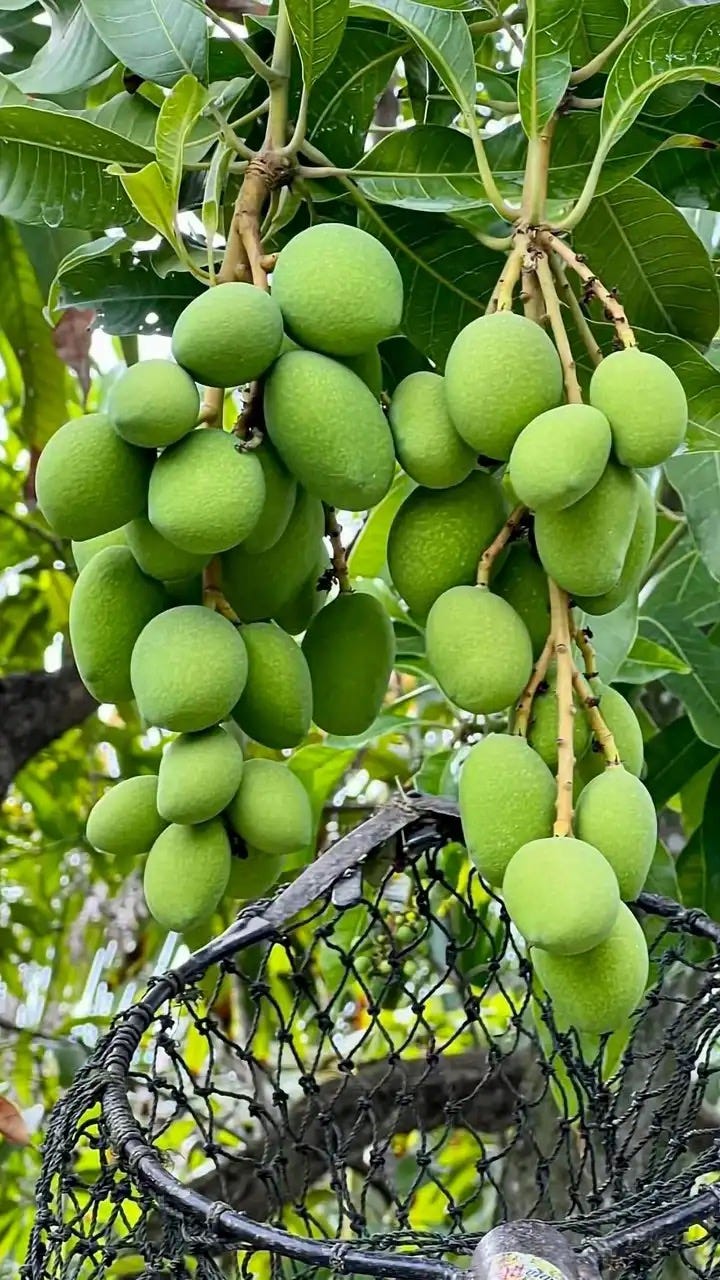
There is a moment in every mango season when the kairi arrives and everyone knows exactly what to do with it.
Pickle it. Make panna. Grate it into a chutney. Move on.
The instinct is so fast, so inherited, that we rarely pause long enough to ask a simpler question:
What is this thing, actually?
I have been cooking professionally for sixteen years. I was trained formally, worked across kitchens in India and abroad, and have spent most of my career thinking about what happens when Indian ingredients meet European technique.
And I can tell you honestly — we have been underselling our own pantry for a long time.
Not out of ignorance. Out of certainty.
We are so sure we know what kairi is for that we never stop to find out what else it can do.
Consider how a French kitchen treats a lemon.
Zest separated from pith before anything else is done — because the zest carries the oil and the pith carries the bitterness and treating them as one thing is a waste of both. Juice reduced to a gastrique — acid and sugar collapsed into something with more depth than either alone. Peel candied, dried, powdered, used as a seasoning rather than a garnish. The same lemon appearing in four different forms across a single menu.
This is not sophistication for its own sake. It is the result of a kitchen culture that asked — obsessively, over generations — what else can this do?
The lemon is not more interesting than the kairi.
It has simply been studied longer.
Raw mango has a tartness that shifts depending on variety, ripeness, and how long it has been off the tree. It behaves differently when salted versus heated. Its acidity is brighter than tamarind, cleaner than kokum, more volatile than either — meaning it changes faster under heat and needs to be handled at the right moment or it disappears entirely.
These are not obscure facts. Any cook who has worked with kairi knows this intuitively.
But intuition and examination are different things.
One tells you what works. The other tells you why — and why is where the real cooking begins.
When I started applying European technique to Indian ingredients seriously, the first thing I noticed was how much information we had been leaving on the table.
A kairi gastrique — raw mango juice reduced with jaggery instead of sugar — has a complexity that stops people mid-bite. Not because it is clever. Because it is more fully itself than the ingredient usually gets to be.
A raw mango powder made from slowly dehydrated slices rather than commercially produced amchur smells like a different ingredient entirely. More floral. Less aggressive. Something you can use as a finishing seasoning rather than just a souring agent.
Neither of these required new ingredients. Just a different quality of attention.
This is what I mean when I talk about rigour.
Not formality. Not making Indian food French — that would be the wrong project entirely and frankly a boring one.
Rigour means asking the question the ingredient deserves.
What are you, actually? What can you do that I haven’t asked you to do yet? What happens if I slow down and pay attention instead of reaching for the inherited answer?
Indian ingredients are complex, regional, and extraordinary. They have been feeding people for thousands of years across climates and cultures that would have broken a less resilient pantry.
They deserve the same obsessive attention that European kitchens have given their own ingredients for three hundred years.
That attention is not a foreign imposition.
It is simply respect — with a sharper knife and more time.